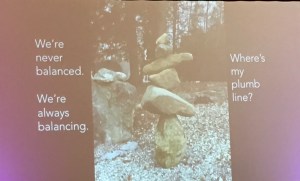
Creating Balance Through Recovery, Rest, and Restoration

Version 3

“A human being needs rest and recovery for optimal psychological and physiological functioning.”
~ Tal Ben-Shahar in The Certificate in Positive Psychology Course

There are times in life when our routines are disrupted, change is in process, unexpected events appear, and deadlines are fast approaching. And, in spite of or in addition to, the routines of our lives continue — work is a must, picking up children and taking them where they need to be, preparing meals, and all the chores of running a household do not pause to make room for the extras that are sure to come along.

How do you handle additional stress and disruptions? What goes to the back burner first? Most of us (me included) tend to skimp on our routines and practices that are essential for our self-care. We put off going to the gym, do not go for that walk in the woods, or go for that early morning run. We reschedule our yoga classes or walk past our meditation cushion to make room for doing the ‘more’ that has presented itself.

I know this because I am guilty of letting my self-care practices go until… the project is finished. I know this because I hear it every day from clients who say, “I’m too busy to take care of myself this week. Once I’m finished with ________, I’ll return to my routine.”

I am currently in the middle of such an unexpected change requiring my time, effort, and energy above and beyond my daily routine. My deadline is fast approaching with, still, much to do.

I’ve decided to approach this deadline differently. I have consciously insisted on rest and recovery when I need it over pushing it to the back burner for later. I am continuing my morning practice, my walks in the woods, and time to simply be or do that which provides for restoration time — like taking a walk around my yard with my granddaughter on FaceTime yesterday.

At first, my mind tried to rebel by chattering on endlessly about the long list of necessary ‘to do’s’ and the limited time I have before my deadline arrives. My mind wants me to let go of time to meditate, write, or hike in the woods by saying, “There isn’t enough time for everything, especially a walk in the woods!”

I, on the other hand, am insisting on continuing all those self-care activities! What I am learning is that allowing myself the time to rest, restore, and recover through my self-care routines and practices is that I am actually getting more accomplished. Yes! Having my self-care needs met means I am more focused on the tasks with fresh eyes and refreshed energy. And, yes, the deadline is fast approaching. I know there is plenty of time to get everything done and take care of myself.

By ignoring my self-care or plowing forward (which I am so good at) I was creating imbalance —ok, for several days I tried to plow through. The imbalance left me arguing with myself or fighting my physical need for restoration and being fully unfocused in whatever task I was trying to do. I was spending a lot of time resentful, frustrated, and scattered which meant valuable time was, indeed, being wasted!

Once I paused to honor my need for balance, everything began to flow with more ease. I am getting more done in less time because I am consistent with my need for rest and restoration through the consistency of my self-care practices.

How do you provide balance in your busy schedule? Do you honor your need for rest and restoration? If you are someone who puts your self-care on the back burner in order to plow through, what can you consider doing, today, to restore balance?


Changing Habits of Questionable and Unrelenting Mental Chatter

Transforming negativity, fear, anxiety and worries to more positive and upward thoughts with neuroplasticity.

Unfolding Beauty

Version 2 IMG_5444

I don’t know about you, but my mind chatters on endlessly, especially when I am making changes, big decisions, or facing some unexpected challenge. It is like an endless loop of worry, questions, old habitual patterns, and over thinking. Sound familiar?

A number of years ago I began to relabel my chatter from ‘annoying interruptions’ to ‘giving myself instructions.’ At the time that relabelled my experience with the endless loop. I felt relief simply by renaming my mental chatter. Since then, I have learned that I have more choice around the conversations in my head.

Now, being someone (in my younger years, of course) who has always viewed rules and instructions with a sharp eye for loopholes and ways to live around the rules, this new label created a doorway of opportunity! I could make a choice whether to listen and follow my brain’s instructions or redesign those messages into a new story — a story with more positivity and hope. I felt a new sense of freedom.

Then, I learned about neuroplasticity and the brain’s ability to create new pathways, new learnings, and, quite simply, change — all the way to our last breath! I read ‘The Brain that Changes Itself’; ‘Evolve Your Brain’; ‘You Are Not Your Brain’; ‘The Power of Neuroplasticity’; and others. Each one confirming my move to change how I viewed my mental chatter!

How refreshing to learn that I did not need to continue living from by brain’s instructions that, too often, sounded old, familiar, habitual, and leaning too far into negativity. These messages were generally old stories or deceptive brain messages (DBM’s for short) that Schwartz and Gladding talk about in ‘You Are Not Your Brain’. Albeit, my brain’s efforts have been noble! All these instructions were & are an effort to keep me safe by keeping me in the familiar old programming — free from risk, new adventures, and considering choices that took me out of my box and into new, unfamiliar territories.

For those who know me, I haven’t been a great rule following model as my life has involved many alternative choices, risks, and leaps into the unknown. However, I have avoided many changes and challenges because my DBM’s have felt so real in my brain and my body — leading me down the path to perceived safety.

What I am learning in neuroplasticity is that my old neural pathways step up their game whenever I am faced with a change, new adventure, or challenge by becoming louder and insistent. Unless I decide to make a new neural pathway of positivity by renaming, reframing, and redirecting my focus. Does it take work? Of course it does! In order to change and create new habits that are positive, I make a plan with reminders posted around my house to remind me of my effort to change.

Here is what I do: First, I identify and relabel my DBM’s as what they are — deceptive brain messages. Second, I thank my brain for its valiant effort to keep me safe. Third, I refocus my attention toward my new direction of a positive habit. It is this last step that takes the daily work of doing and affirming – over and over again. It takes anywhere from 20 – 30 days of consistent effort to create a new habit (sometimes longer). My judge is when I am doing and acting in a new way without having to remind myself. Personally, I like to create 30 day challenges for myself, inspired by the Certificate in Positive Psychology Course that I’ve taken — a month is a nice stretch of time to begin carving a new neural pathway!

I must add that the deceptive brain messages and instructions don’t necessarily go away. In fact, my clever brain continues the endless loop just in case I am not paying attention! I simply keep returning to relabeling the chatter and sensations as deceptive brain messages (not based in current reality but following old programming), reframing by thanking my brain, and refocusing my attention in the positive direction I would prefer to follow.

Begin to notice what deceptive brain messages are chattering inside you! Then either try what I’ve suggested here and/or go get the book, ‘You Are Not Your Brain’. To learn more about the Certificate in Positive Psychology I mentioned above, go to http://www.wholebeinginstitute.com, to learn more. Best of luck and enjoy the more positive you!

“Your mind is your biggest ally. It gives you the capacity to choose where to focus your attention so that your actions align with your true self.”
~ You Are Not Your Brain


Embodied Positive Psychology Summit

IMG_2354

Lucky me! I just spent the week immersed in positivity at the Embodied Positive Psychology Summit held at Kripalu Center for Yoga & Health! What an inspired week connecting with fellow students of the Whole Body Institute and meeting new friends as we explored how we carry forward the principles of Positive Psychology. Throughout the week there were numerous workshops, speakers, excited conversations, and opportunities to clarify and consider how we, both as individuals and community, will continue to live our lives directed by the science of meaning, happiness, and purpose. I am still wonderfully full as I look through my notes, photographs, and remember — it surely has been a week of memories!

Some of the topics discussed were ~ how character strengths support whole being; embodying compassion; resiliency; living with lovingkindness; the art of authenticity; embodied gratitude; positive psychology and narrative practices (the stories we live); songwriting with soldiers (not a dry eye in the room listening to this essential project); the connection between yoga and embodied positive psychology; spirituality; prioritizing positivity; and oh so much more!

Many of the speakers were fellow Positive Psychology students/colleagues ~ how exciting to hear how they are finding their niches in carrying all that we’ve learned into the world!

Personally, I was over the moon listening to Sharon Salzburg, Maria Sirois, Neal Mayerson, Tal Ben-Shahar, Megan McDonough and Barbara Fredrickson!

The focus of the week was Embodied Positive Psychology which looks at the whole person – body, mind, emotions, and spirit – and how we can and must embrace positive psychology. There were yoga classes, healthy meals, and (a high note for sure) Megha led her awesome ‘Let Your Yoga Dance’ sessions each noon break.

I am so grateful from every experience this week! I am also inspired to continue my living positive psychology and doing my own work in the world! I’ll finish with the spirit of loving kindness which truly was a theme throughout the week.

May you be happy
May you be healthy
May you know ease of well-being
May you be at peace.

What is Positive Psychology?

Version 2

Positive Psychology is the study of what makes people thrive and flourish. Who are the people who thrive and flourish? Those who live their lives with a positive resilience that leads to living life happier and with meaning and purpose. Back in 1952, Abraham Maslow was the first to write a chapter in his book called, “Toward a New Positive Psychology”. To many, Maslow is considered a grandfather of positive psychology. He proposed that we study those who excel at what they do whether a sport, business, art, writing, etc. and those who are happy and living successful, fulfilling lives in order to learn from them.

Positive psychology became a branch of the larger field of Psychology in 1998 by Martin Seligman, the head of the American Psychological Association. Martin Seligman is the author of ‘Learned Optimism’ and ‘Flourish’. His work, as well as many others, has looked closely and done much research about what makes some people flourish, live happy, live life fully with meaning and purpose, and have a strong sense of resilience – the way we move through challenge and into opportunities. In other words, those who look at their glass as half full vs. those who look at their glass as half empty.

My own studies began in the late 1970’s and early 1980’s in the field of Humanistic Education and, more recently, with Tal Ben-Shahar, Megan Mcdonough, and Maria Sirois through the Whole Being Institute. For the past five years, I have immersed myself in learning, living, and teaching positive psychology. Of course, my dream is that we all learn to live more in harmony with one another and reach for living more fulfilling and happy lives.

The field of psychology has been quite successful in helping many people, including myself, overcome and/or live with anxiety and depression as well as heal from trauma and abuse. I acknowledge that there are times in many of our lives that seeking help from a therapist is needed. What positive psychology does is study the other end of the continuum — those people who excel at what they do and live happier than most people — so that we all can learn to thrive and excel ourselves.

My latest interest and the inspiration for this blog is the blending of happiness and health in order to live at our best while being both happy and healthy.

The next question that is often asked is, “Does this mean we should be happy all the time?” Well, no! All of our emotions are essential for living a full life. There are times when life is difficult, when there is loss, and when other emotions take front and center. We are all our emotions — angry, sad, frustrated, joyful, happy, overwhelmed, etc. — and positive psychology is about feeling all of them as they are present. The more fully we feel one emotion, the more fully we feel all of them. We are all human. A premise of Positive Psychology that I learned from Tal Ben-Shahar is ‘the permission to be human’. This is acknowledging that all emotions are part of living a full life and when we give ourselves permission to be human, we are also giving ourselves the permission to feel the feelings that are present in the moment.

We can learn to live more fulfilling and happier lives through practice. Barbara Fredrickson, the author of ‘Positivity’ and one of the pillars of positive psychology talks about building our positivity ratio — our ratio of positive experiences to negative experiences. The ideal is around three positive experiences to one negative experience on a regular basis to find our life moving in an upward spiral of increased happiness and fulfillment (I wrote of this in an earlier post, ‘Collecting Happy’). What this blog is about is offering regular exercises that we can practice to build our cache of positive experiences to balance out the negative in our lives.

You see, I like looking at my glass as half full! I choose to fill my days with practices that lead me to being happier and building my resilience for those times of challenge. Am I happy all the time? Of course not, though the more I practice, the happier I am overall. I hope you will join me!

Early Morning

Cardinals welcome the day serenading anyone listening
Woodpeckers keeping rhythm from tree tops
As the sun paints pastels on the underside of clouds

The cold clear air providing a spacious echo
Green pokes through snow promising hope for the daffodils
Tiny leaves reaching forth from branches

A feast for the senses this early morning
before the sun rises over the horizon
promising Spring unfolding.

Version 2

Early morning before the sun rises over the horizon is my favorite time of day to be outdoors. It is quiet then and I continue my morning thoughts & considerations as my dog finds her way around the smells of the night. Always, I delight in the magic of early morning as the birds begin their song and I imagine they are welcoming the return of yet another day.

Today, called for a hike into the woods. So off I went. It is a cold April day with a wind chill that bites my cheeks. I keep going — legs moving, arms swinging, and my breath adjusting to both the cold and the pace. As always, the first mile is the hardest as I head up a mile before leveling to a steadier terrain.

Hiking is my ‘go to’ when, not only do I want exercise, I also want to contemplate life, process the complexities of my days, and find myself whole again and cleansed when I return. I always know that my hikes change my perspective on my life which, like everyone, has it’s share of stress and drama. Today, I took a detour through the woods to pause at the edge of a hidden mountaintop lake — gratitude fills me at the simple beauty and awe all around.

Exercise is well known to be even better to allay depression and anxiety for most people. I, personally, find that to be true. Once I get beyond the first mile or twenty minutes I can feel my body and mind let go into a rhythm of more ease and emotionally more centered. For many years, I found this release through swimming and running. Now, hiking and being surrounded by nature is my exercise of choice. I find the meditative experience that accompanies being in nature is what I crave. What is your exercise of choice?

Choice, Every Moment, Everyday

Version 2

What choice can you make today to be 5% happier? This is a question I ask on those gray days— whether gray outside or inside. Sounds so easy to make different choices and, yet, not always so easy. Today happens to be one of those days for me. I woke up to snow and wind (and, yes, it was forecast) which, surprisingly, I was disappointed that the forecast was correct in early April. I decided to finish a book I’d been reading. Once I finished the book, I found myself wandering around the house with little that interested me in doing. After about an hour of wandering, I decided to ask myself, “What can I do to be 5% happier right now?”

Making choices to be just 5% happier takes practice, mindfulness, and commitment with each choice. How do we begin? It is as simple as asking the question and waiting for an answer. Within minutes, I did decide to cook (which always makes me happy). Doing one simple thing changed my mood from OK to feeling satisfied and looking forward to dinner.

Through studying Positive Psychology, I have learned to ask questions, such as, what can I do to feel 5% happier. Other questions I ask help re-direct my focus from what I think isn’t working to focusing on what is going well and what is good. So I will ask myself, what is going well right now?; what can I do or say to feel differently?; who can I be that is more positive, mindful or present?; what can I appreciate more in this moment?.

One of my favorite questions, ‘Who do I want to be today?’, is a question I ask myself most mornings as I finish my journal writing before heading off to my day. My answers set a positive tone and intention to my day which has made my life more meaningful. It has become a positive anchor that I create each morning for myself and am, then, better prepared for the curve balls that life throws my way (most days there is at least one unexpected curve ball).

At the end of my day, in my evening meditation, I answer another question, ‘What am I grateful for?’. Gratitude has been proven to have lasting benefit toward a positive life and better health. For me, I remind myself of those experiences, things, people, animals, and family that make my life richer (even a good meal or a great movie find their way to my lists). Sometimes on my list are experiences that weren’t so positive but I learned from them. Acknowledging my gratitude keeps me from taking my life for granted. When I end my meditation and tuck in for the night I go to sleep with a full and open heart.

Each day we make choices — what to wear, what to eat, when to exercise, what to pay attention to, read, learn and do. I like knowing that I have choice. We also have choice around how to react, how to be present, and how we want to feel. Mostly, my choices have become much more mindful and positively focused. As a result, I am overall, happier doing what I love and living with purpose.

So, I’ll end here with how I began…

“What choices can you make today to be 5% happier?”

New Experiences, New Neural Pathways, And Lot’s of Fun!

Spent the weekend with my grandchildren which always feeds my happy & healthy with play, adventures, and fun. This weekend was filled with ‘first’s’ which I am grateful to participate in and witness.

My 5 1/2 year old learned to tie her new shoes! Version 2To be sure a new neural pathway was formed in her brain, she tied & untied, tied & untied, over and over again. Each time she was ever so proud of her accomplishment!

For my 14 month old, he participated in his first Easter egg hunt. After the first two finds with the help of his Dad, he was off and running to keep up with his sister.

Version 2 The day before Easter, the sun was shining so we headed outdoors with sidewalk chalk on the driveway — nothing like fresh air, creativity, and keeping up with a toddler learning to run with his new shoes to feed the soul with joy!Version 2 For me, my fun was photographing the events when I wasn’t dying eggs, filling eggs, working on puzzles, or joining the fun with sidewalk chalk!
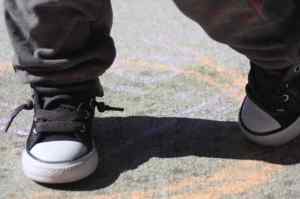


My return home is full of memories, appreciating my family, and looking forward to our next adventures!

An Important Book Review: A Short Course in Happiness after Loss by Maria Sirois

Maria Sirois
Maria Sirois is an elegant and graceful storyteller with a wealth of stories from her own life and work. In her new book, A Short Course in Happiness After Loss, she reminds us that loss is an inevitable part of life which none of us is spared. Through her writing about loss, and I mean the kind of loss involving abrupt change to the core of our being and the way we think life is or should be. Losses such as death, divorce, and illness. These are kinds of loss that alter our reality (and often instantly) where we are taken out of our day-to-day normal and brought into the depths of raw and consuming emotion. All of these losses involve grieving and require time to heal.

Maria leads us through the journey with full permission to be in all the mess and emotion for as long as it takes. She leads us on an upward spiral through grief, hope, courage and onto the possibility of happiness with baby steps of awareness to rise up and see life as it is — a co-existing of good and bad, of up and down, of messy and orderly, sadness and joy. Maria’s authentic and raw honesty goes right to the heart and opens the door to moving forward into a life of meaning and pleasure. She is not talking at us about loss. She leads us, through real experiences, onto the path to healing.

Slowly, with tenderness and respect, Maria shows us that happiness — a life of meaning and joy — is possible when we begin to notice what is good, what is beauty, and onto what can be a new normal with joy as well as loss.

I was reminded of the morning my mother died and I went for a hike in the woods to cry, to remember, and to be cradled in the arms of nature. It was there I found a robin’s egg, newly hatched. I saw that coexisting was the metaphor of the release of my mother from this life for which I felt enormous grief and a glimmer of beauty and life continuing on in spite of the empty well I felt knowing my mother was gone.

Yes! I highly recommend Maria’s book for everyone, since loss does not discriminate who will or won’t experience loss. We all will, at some point. This book is an important guide through loss to the other side. A great short course to be, perhaps, better prepared when loss finds itself into our life. If you are in the midst of loss and wanting to find your own way to a new normal, this book is a beacon to find your own courage, awareness, and bravery on your journey.

Living in Strength


Mountain Goat Utah

“Curious people pursue experiential novelty, variety, and challenge.”

I thought I would be writing about mindfulness in this post. However, what I am full with this morning are my strengths — love of learning and curiosity. So I am going with the flow and will write about mindfulness at another time.

I have spent too much time in my life in judgement and self-criticism around what I thought were my faults. I have worked hard to try to fix them with all the New Age approaches and therapies I could use — affirmations, visualizations, energy healing, journaling, and reading every self-help book I could lay my hands on. I also spent years in therapy through my 20’s and 30’s trying to understand and looking at my past as the focus of blame and trying to repair my faults. All of my efforts provided few lasting results. I still struggle with forgiveness and teamwork. Sound familiar?

Then, several years ago I found the Certificate in Positive Psychology course through The Whole Being Institute and offered at Kripalu. I became immersed in Positive Psychology which is grounded in the science of what is good and what is working in life. Rather than looking only at what needs fixing, Positive Psychology looks at successful, happy people and looks at what they do that makes a difference regardless of their past (or present circumstances). What a game changer this has been for me!

Note: if you want to shed light on your life and begin living from what is working, go to Whole Being Institute (www.wholebeinginstitute.com) and consider investing positively in yourself.

One area of Positive Psychology that has had a tremendous impact on my day-to-day life has been the study of strengths and learning to live more from my character strengths while nurturing some of the strengths that are not at the top of my being in the world.

Learning about virtues and strengths that are universal opened my eyes to a whole new world and a positive focus in my life as well as those I work with. Martin Seligman and Chris Peterson (two top psychologists in Positive Psychology research) wanted to know about the strengths that are inherent in people worldwide. Through their research and work, they found there were six virtues — wisdom, temperance, transcendence, courage, justice, and humanity — that are commonly valued across cultures. Within those six virtues are twenty-four strengths that are also commonly valued worldwide. They are: creativity, curiosity, open-mindedness, love of learning, perspective, bravery, persistence, integrity, vitality, love, kindness, social intelligence, teamwork, fairness, leadership, forgiveness, humility, prudence, self-regulation, appreciation of beauty and excellence, gratitude, hope, humor, and spirituality. These strengths exist in everyone to varying degrees. Seligman and Peterson found that everyone has strengths that are used more than others and that through questioning we can learn what strengths make up who we are as individuals (a personal blueprint of strengths) in our lives. Our top five to seven strengths are used most and are referred to as our character strengths or those that make up who we are in our day-to-day.

Note: Go to http://www.viacharacter.org to learn your personal ranking of the 24 strengths. There are, also, other organizations that offer strengths questionnaires for you to learn yours. A simple Google search will lead you to several.

When I took the VIA (Virtues in Action) questionnaire I saw my personal blueprint showing my ranking of the twenty four universal strengths. I had an ‘aha!’ moment! I was pleased and sat with a clearer understanding of who I am in my life to myself and others.Though my most used strengths were no surprise, they were a relief to know, and my understanding of myself expanded.

My character strengths (or my top 5 – 7) shed light on how I think, act, and present myself in my daily life. What was even more enlightening were the strengths, though present, that are not my most used. The two at the bottom of my list of twenty-four are the ones I’ve judged (and been judged for) myself for not expressing easily. I felt ‘off the hook’ for my life-long struggles to be different than I am and more like others.

Fun for me has been identifying when I am using my strengths, being mindful of using them in new ways (there, I am writing about mindfulness), and when I am spotting strengths in others. I am also learning to use my top strengths to nurture those strengths I use less, yet would like to use more.

“Teamwork is a strong sense of duty, works for the good of the group rather than for personal gain…”

Teamwork is not a top strength for me which explains why I work so much better being self-employed and in a solo healthcare practice. Now, I’ve been on many teams in my life (as an athlete in my youth, teamwork was important), however, teamwork isn’t something I often seek out now that I am older.

Last fall I was accepted to work as part of a team of teaching assistants for the current year-long course in Positive Psychology. I realized it as an opportunity to use the year to strengthen my skills of teamwork. I thought it would, at times, be a challenge to be communicating, working with and sharing responsibilities to guide a group of new students into and through a year of Positive Psychology study.

I must admit that there have been times in my adult life where I would not have even begun such a journey. There have also been times when I would excuse myself (yes, quit) to return to my solitary and comfortable way of being.

This time, however, my commitment is to continue and learn all I can while immersing myself fully in a team. My two top strengths — love of learning and curiosity — I am using to bolster teamwork in myself. I like to look at it as tethering my top strengths to one that I want to develop and master more. I am using my love of learning (learning all I can about myself and the team I am part of) and curiosity (my natural tendency to explore) to become a better team player.

What fun I am having!! I love the journey and am making new life-long friends in the process. I am even more passionate about Positive Psychology and working with others to extend the outreach of happiness in the world. I am appreciating my team and grateful for this opportunity (two of my other character strengths). I know I will continue to look for more teamwork possibilities in my life and will do it again and again!

I highly recommend you find out what your top/character strengths are and find ways to consciously live from them. I know you will be happier, healthier, and experience a more fulfilling life. For yours, go to http://www.viastrengths.org.

Smile, Look Up & Expand Your Body

PeaceBirch

These are three simple adjustments we can make anytime, anywhere, to change our mood, lift our spirits, inspire self-confidence, and communicate our strength and positivity. They are smile, look up (yes, that’s right, look up to the sky), and expand your body or as Amy Cuddy in her book, Presence, calls stand in a power pose (more from Amy Cuddy later).

  1. Look Up:

Looking up is a simple action with powerful results. If we are worrying, feeling blue, or stressing about something, our eye gaze tends to be down — anywhere below eye level. A simple adjustment to our mood is to look up. Lifting our eyes and head to look up changes our posture — we stand taller, open our chest & heart, breathe deeper, and feel lighter and more joyful.

I remember working with young children who were mostly from troubled families. They would come to Day Care each day with their feelings on their sleeves or in their fists. When they walked, they often looked down toward the ground. When someone approached them, they would startle or duck down. When sitting, they would wrap their arms around themselves as if protecting their hearts from harm. On walks or even indoors, I would have them look up toward the tree tops or the sky and tell me what they saw. This simple shift in their gaze lightened their mood almost immediately with laughter and open dialogue soon after.

This simple practice of looking up is something I do on all of my walks. If I am feeling down or out of sorts, I will walk outside and look up to the sky. I’ve known for many years that looking up changes my outlook, lifts my spirits, and I go about my day in a more positive frame of mind. I am even convinced that on long hikes or runs, when I look down at my feet I feel more pain in my body and when I look up, my pain diminishes and often releases entirely.

This has been my little secret awareness for many years until reading Amy Cuddy’s work on how we hold our bodies, I now know there have been studies done that support what I’ve known all along! When we change our posture to a powerful pose (expanding, looking up, and becoming bigger) rather than a powerless pose (folded in on ourselves, looking down, shoulders rounded) we benefit by feeling more self-confident, self-assured, less anxiety and depression, and less physical pain.

Looking up! How simple is that!

2. Smile:

Another simple practice I use is to smile. My Positive Psychology instructor, Tal Ben-Shahar, teaches that it isn’t just any smile, but an authentic smile which includes smiling with our eyes. We all know the fake smiles. We’ve seen them in photo’s of people who are told to smile for the camera but aren’t really feeling it — they are smiling only with their mouths. An authentic smile is one where we smile with our eyes as well as our mouths!

When you look at someone or a group of people and they are smiling or even laughing, what do you naturally do? Of course, you smile or laugh with them even if you don’t know what they are happy about! Laughter and smiles are contagious and they feel good because they communicate to the brain to release ‘feel good’ chemicals (hormones).
My first Qi Gong class always ended with the instructor saying, “Put a smile on your face and then open your eyes.” With a smile, I breathed deeper, stood taller, and moved onto the rest of my day in a more positive mood.

Research now shows that the posture we hold triggers our brain to release different hormones that match our posture. A simple act of changing our physical posture with a smile directs our feelings and our actions. When I wake in the morning, I stretch, pet my dog & cat, and put a smile on my face — all before getting out of bed. This daily ritual sets the tone for my day.

I challenge you to practice waking each morning and, before tossing back the covers, put a smile on your face first and then see how you feel and act. Imagine everyone in your family or circle of friends beginning the day with putting a smile on their face!

3. Expand Your Posture into One of Power:

Amy Cuddy, in her book, Presence, talks at length about how we carry ourselves — our posture. She says, “The way you carry yourself is a source of personal power – the kind of power that is the key to presence.” Her research and that of many others sited in her book, substantiate that expanding our body by standing taller, opening our chest, looking up, and arms open (not wrapped around ourselves) has many benefits. When we stand in a powerful pose we communicate presence, self-confidence, and self-assurance. We are more creative, courageous, generous, resilient, and open. In her words, “It doesn’t change who you are; it allows you to be who you are.”

When we stand or sit with our posture open, powerful, and head held high, we communicate and feel very differently than when we sit or stand in a powerless position with head bowed, arms wrapped around ourselves, and our shoulders rounded.

Try it. Walk around the room in a powerful, open posture. How do you feel? Then, change to a powerless posture and notice how you feel. When we stand in a more powerful way we feel happier, more optimistic, confident, and less stressed or anxious. We can more easily access positive memories and positive outlooks when we stand in a powerful way.

These are three simple practices that communicate to our brains to feel better by releasing positive hormones. I encourage you to try them out and then share them with those in your family and circle of friends. If everyone did that, we would find ourselves living in a better world with happier people!

Lastly, I highly recommend reading Presence by Amy Cuddy. She also has done research on the not so positive effects of technology (head bowed over a cell phone, texting, playing games, watching the news) and the posture that is being expressed worldwide…